
How the invisible hand of culture changed one life abroad
Lisa La Valle on losing assumptions, practical hacks (24‑hour clocks, social anchors), and why she wrote 101 Culture Hacks
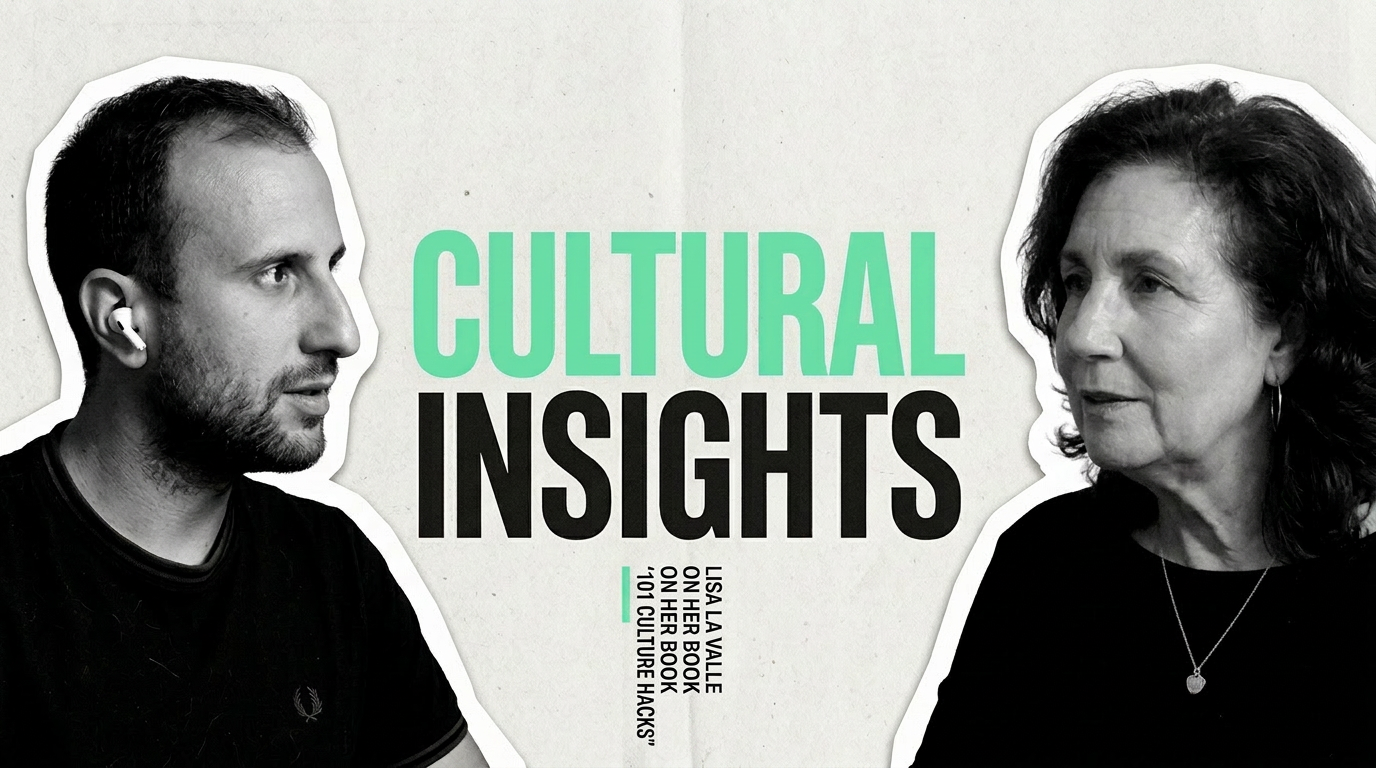
“Fish discover water last.” Lisa La Valle opens with that line and the recording pivots: culture isn’t background noise, it’s the software that runs a life abroad, and you have to know your own settings before the new place can make sense.
Why start with yourself
Lisa, who grew up in Southern California, has lived in Greece, Spain, the UK, France and now Italy. She's an anthropologist, cross‑cultural trainer and essayist who says her first job when she arrives anywhere is a diagnostic: who am I, culturally speaking? That, not a list of dos and don’ts, is the missing tool most foreigners bring with them.
She frames the problem this way: companies buy a cultural consultant as an "insurance policy" to help employees land in a new office. That’s useful, but it skips the inward step. If you don’t reflect on your hometown assumptions (how you speak, how you take space, what comforts you expect), you’ll repeatedly run up against mismatched expectations.
A concrete example she uses: different reasons produce the same behavior. Americans can seem loud because they need to be comfortable with strangers in large public spaces. British aristocratic command comes from a history of owning large rooms and owning a voice. Geography, class, history, they all shape everyday gestures. Knowing that helps you stop taking offense and start translating.
Small, specific things that knock you back to child mode
Some of the most destabilizing moments are not political or philosophical, they’re practical. Lisa lists the tiny measurement shifts that sabotage confidence:
The 24‑hour clock and how a simple hair appointment can reduce you to counting (13 = 1pm).
Different ways of measuring weight, telling time or counting floors.
These are the “you’re seven again” moments she says often cause the most anxiety. They are fixable if you treat them as data points: practice them, keep a cheat sheet, and be generous with yourself while you recalibrate.
Language: not a prize, often a tool
Lisa has studied languages for years, French for eight years, Greek early on, B1 Italian now, and her verdict is practical: you can get by without fluency. She calls her variety of Italian “I get the job done.” The point isn’t perfection; it’s intelligibility. Someone will often know some English; you can communicate in other ways; the goal is to be effective, not performatively native.
She also distinguishes the role language played at different stages of life. At 24 she wanted to be a chameleon in Athens, dress, sound and move like the locals. At midlife she’s content being an Italian‑American woman who works, writes, and appreciates the culture without needing to be entirely assimilated.
Social life: find an anchor and protect it
For Lisa, routine is a social anchor. Work provided predictable social contact: an English department she could rely on, colleagues she could chat with, and that steadiness kept the noise of relocation from tipping into isolation.
Her warning is blunt: “You must make the effort.” Isolation for many foreigners is soul‑crushing. Join language exchanges, networking groups, say yes to the awkward coffee. If you’re lucky enough to find social contact through work, treat it like oxygen.
Money matters: why cost of living was a decisive lever
Lisa’s move was also economic. Divorced at midlife and mindful of U.S. healthcare, debt and consumer pressures, she chose Europe in part because the math and social safety net simplified life. She says her rent and lack of debt are laughably modest to friends back in the States, and that fewer financial worries translated directly into lower stress and more room to write.
She’s explicit: having Italian citizenship cuts out a huge chunk of bureaucratic anxiety (permits, renewals). That advantage matters; it’s a practical constraint that reshapes the living abroad experience.
Best and worst, the tradeoffs she still carries
Best: calmer stress levels, values that align with her priorities, and time to focus on writing. She’s lived in Paris and now Brescia in northern Italy; the reality rarely matches the Tuscan‑sun postcard, but it delivers a lifestyle she chose.
Worst: distance from family. Lisa sees her grown children two to three times a year. That gap is the real price to pay, one she doesn’t minimize.
"Check your arrogance at the door and bring your kindness. Consider every encounter knowledge." - Lisa La Valle
Why 101 Culture Hacks exists (and how it works)
Lisa wrote 101 Culture Hacks to bring anthropology out of journals and into everyday life. The book is organized like an indexed guide: alphabetical entries that answer micro‑questions, hygiene, affection, irony, so you can flip to a real moment and find context, not theory. The goal is practical curiosity: if something knocks you, open the entry and get perspective.
She’s offering five preview hacks from the book on her site and is actively seeking a literary agent to reach a wider audience. Her site is expatwhisperer and she welcomes questions at [email protected].
The single line she leaves every newcomer with
Her top tip for Americans moving abroad is simple and specific: check your arrogance at the door and bring your kindness. Treat encounters as data, not judgments.
If you’re thinking of moving or you’re new to a place, Lisa’s conversation is a reminder that the work is partly inward: translate yourself first, then the new city will be easier to translate back.
If you want the taste of the book, Lisa is sharing five preview hacks on expatwhisperer, or listen to the full conversation for the stories behind the examples.