
How a bar, walking and small-town politeness made Ireland feel like home
Willa Goodfellow on writing in Costa Rica, serving as a priest in Ireland, and the concrete moves that helped her belong abroad.
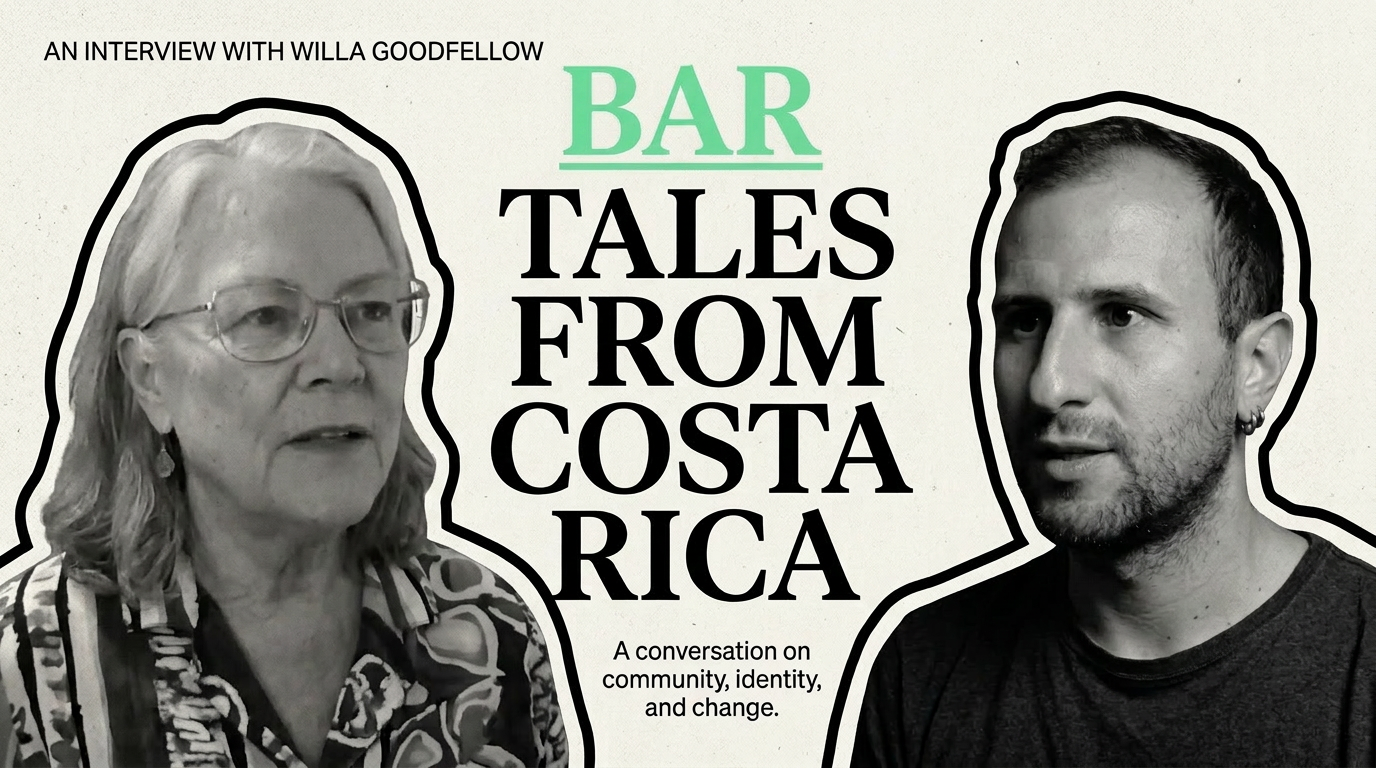
"Don't consume this beautiful place. Just open yourself to it and join it." - Willa Goodfellow
Willa Goodfellow says she wrote half her first book in one week while in Costa Rica, during a hypomanic episode, and later learned to turn the chaos of volcanoes into stories. That image of creation starting in disorder runs through the conversation: a bar called Pato Loco, a neighborhood where people walk everywhere, and a small parish that noticed when a priest arrived.
The bar as a civic center and the small moves that mattered
Willa’s Pato Loco wasn’t just a place to drink. Her sister Mary Ramona owned the bar and it functioned as a community hub, events, service projects, and a steady stream of people with stories. Many of the book’s scenes came from overheard, repeated moments: a hungover neighbor arguing with a bird, vendors laughing when Willa left her bank card at the fruit stand, and the daily texture of a village where everyone greets each other.
The integration tactics were simple and specific: they chose non-gated neighborhoods, walked instead of taking rides, learned to ask questions about trees and food at the market, and practiced small courtesies, "Good morning, how are you?", before conducting business. Those tiny rituals made locals assume they’d lived there longer than they had.
Willa gives practical color: they lived in a 550 sq ft house, walked everywhere, and at one point subsisted on roughly $500 a month (she now budgets closer to $1,000). She calls the life "camping without appliances": fewer comforts, more contact.
Serving as a priest changed what belonging looked like
Willa is an Episcopal priest who now serves part-time with the Church of Ireland. That role opened doors different from the typical foreigner route. In Costa Rica she couldn’t function fully within the church hierarchy, but in Ireland there was a real need, no priest in her village, and people welcomed her into community roles they missed.
She points out a practical rule of thumb for newcomers: even if you aren’t religious, attending local church events signals you share values important to the community and gets you invited to gatherings. Willa also notes the constraints that come with pastoral identity: stories told in pubs in Costa Rica were fair game for her books, but in Ireland she’s mindful that parishioners don’t expect their conversations to be written up.
On being received as a lesbian couple, Willa’s experience surprised her. In Costa Rica she was told bluntly, "Costa Rica is a free country," and neighbors treated them without fuss. In Ireland, particularly on the Dingle Peninsula where she lives, legal and cultural shifts (including marriage equality by referendum) meant acceptance felt rooted in family ties and concern for younger generations.
Concrete nuts-and-bolts advice for anyone thinking of moving
If you want the practical side, Willa pulled plenty of specifics from her years of back-and-forth life:
House hunting: walk neighborhoods and look for hand-lettered signs, Se Vende (for sale) or Se Alquila (for rent) with a phone number.
Language: immersion works. Start by asking simple questions at markets and hardware stores, "What's that fruit?", and build from there.
Transport: many towns use golf carts; intercity travel has buses (sometimes modern, sometimes repurposed school buses) and two international airports (Liberia and San José). Taxi networks rely on local drivers rather than ride-hail apps in smaller towns.
Health and cost: healthcare mixes public and private care. For serious issues, aim for a private hospital in San José. Cost of living depends on lifestyle, buying local produce and living simply can be very affordable; mirroring a U.S. lifestyle can be expensive. Willa estimates past spending at about $500/month in a very minimalist setup, now closer to $1,000.
Bureaucracy: every country has it; the forms and delays sit in different places. Expect odd workflows (multiple people involved in a simple purchase) and learn where things really get done.
Her top piece of advice is more cultural than tactical: embrace the place rather than remake it. Pura vida, she says, is not just a slogan, it's an approach.
If you want the full texture, the bar anecdotes, the liturgies she describes, the exact scenes that became chapters of Bar Tales from Costa Rica, and the way being a priest shaped what she could and couldn’t publish, the conversation with Marc goes into all of it.
Listen the episode to catch Willa’s stories in her own voice, and to hear the line about chaos and creation that threads the whole conversation.